Nationalist Party
Naked LunchThe Nationalist Party is presented through political performances that promise ordinary life while turning crowds, ceremonies, and public disorder into instruments of power. Its leader speaks from a balcony above the Market, plans a riot as though it were a football play, and later calls the outbreak “the voice of the People”; the contrast makes the Party’s populist language inseparable from the manipulation and violence surrounding it.
Leadership and Public Image
At a Nationalist Party luncheon on a balcony overlooking the Market, the Party Leader strides among cigars and scotch wearing a jellaba, expensive English shoes, loud socks, and garters. The description combines the trappings of wealth and authority with the appearance of a successful gangster in drag. His political theater is directed toward a lieutenant: he points out over the Market and asks what the man sees. The lieutenant answers that he sees the Market, but the Party Leader corrects him, insisting that the view consists of ordinary men and women going about ordinary tasks. That everyday life, he says, is what the Party needs.
The staging immediately undercuts the speech. A street boy climbs over the balcony rail, and the lieutenant abruptly calls out to him about used condoms before cutting the scene. The interruption punctures the leader’s polished picture of ordinary life with the unruly commerce and sexualized street world just below the balcony. The Party’s appeal to the people is thus presented not as a stable account of their lives, but as a theatrical image vulnerable to the city’s unscripted intrusions.
Crowd Politics and Riot Planning
The Party Leader describes the next riot as something that will go off like a football play. The plan involves a thousand “bone fed, blue ribbon Latahs from Indochina,” with the organization needing only one riot leader for the entire unit. A lieutenant wonders whether the participants can be set in motion by imitating one another in a chain reaction. The exchange turns collective action into a problem of choreography: the crowd is discussed as a mechanism that can be started, replicated, and directed.
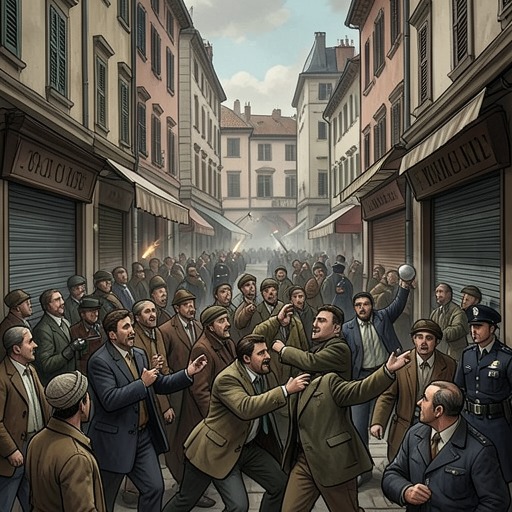
When shutters slam and patrons rush inside amid panic, the Party Leader raises his hand and announces, “The voice of the People.” The phrase gives political meaning to a volatile public scene, but the surrounding action complicates any claim that the crowd speaks independently. The Party’s prior discussion of a planned riot and imitative behavior has already framed mass response as something open to orchestration. Its populist formula can therefore function as an appropriation of public disorder: the leader names the crowd’s voice at the very moment that fear and movement make it difficult to distinguish spontaneous action from managed spectacle.
Political Spectacle and Institutional Violence
The Party’s scenes belong to a wider world in which meetings and public ceremonies are governed by performance, intimidation, and sudden violence. At gatherings attended by representatives of many Arab parties, delegates are searched at the door, yet the meetings repeatedly end in riots. Speakers may be doused in gasoline and burned, concealed weapons are brought into the hall, and a bomber’s grenade can turn a gathering into a scene of mass casualties. Against that background, the Nationalist Party’s interest in designing a riot is not an isolated joke: the text repeatedly joins political assembly to the possibility of force and catastrophe.
The Party’s theatrical treatment of politics also echoes coercive colonial ceremony elsewhere in the book. On the Island, the population must attend the annual lease-renewal ritual at the municipal dump. The President crawls across the garbage to deliver the residence permit to the British Resident Governor, while soldiers in jeeps sweep machine guns across the crowd. The Governor jokes that everyone is happy to remain, and the crowd laughs under the searching guns. The Island’s democracy is formally maintained through a Senate and Congress, but their jurisdiction is restricted to garbage disposal and outhouse inspection. These episodes sharpen the distinction between political forms and actual power: public participation may be staged, compulsory, or constrained even when it is presented as consent.
Narrative Function and Significance
The Nationalist Party appears not as a continuously narrated political organization with a fully described membership or program, but through episodic scenes that expose the gap between official language and the actions surrounding it. Its leader’s talk of ordinary people is interrupted by a street boy; his image of popular life gives way to a plan for a riot; and his later appeal to “the voice of the People” arrives amid panic and disorder. The Party’s identity is built through these reversals rather than through a systematic account of its institutions.
This fragmentary presentation makes the Party part of the book’s broader satire of power as performance. Political leaders claim to represent the public, yet crowds can be treated as units to mobilize, ceremonies can disguise subordination, and the language of consent can accompany armed control. The Nationalist Party’s most revealing gesture is therefore not a formal declaration of policy but the leader’s raised hand: he assigns a political voice to a crowd whose agency the surrounding scenes leave radically uncertain.